Tag: rock climbing

Navigation for Rock Climbing

In the previous blog ‘A Climbing Framework for Sport Climbing’ we looked at a framework as an aid to better decision making for leading. The framework included a simple formula for navigating between the bolts: 

Navigate only for the feet, choose hand holds based on the direction you want your feet to travel. Go where it is less steep overall for the feet but be sure to risk assess your chosen route before committing to it. 

In this blog ‘Navigation for Rock Climbing’ we are going to provide a deeper explanation of the rationale behind it because, although it sounds simple, it’s a bit like learning to use contour lines when map reading. It takes some practice before the information jumps out at you, and you also need to fully understand and trust the process to commit to practising it.

Find -and climb- the easiest way

Apart from safety and coaching efficient movement, route-finding or navigation has become a primary focus when coaching outside. The fundamental concepts of moving more efficiently are usually easily understood as there is immediate feedback of the climbing feeling easier, the upper body having to work less, and the arms not getting as tired. On a Coaching Course, which is 5 climbing days filled with video analysis, theory and drills and exercises to understand and practise efficient movement, climbers improve on average two grades in one week. With navigation, people can take a long time to understand and engage in the process, especially because seeing the change in angles is difficult at first and it requires climbing routes in several different (steeper and less steep) ways to compare and get the evidence. Plus, after the week of climbing outdoors, this skill can not continue to be practised indoors. In our experience more than 90% of the climbers that we work with climb at least 2 grades harder indoors than on rock. People were still way off their true potential despite the obvious improvements in their movement skills. So, we realised we needed to put a greater emphasis on route finding. However well you move on the rock and whatever strength and fitness gains you make, none of it will fully translate to your maximum grade if a good percentage of the time you are navigating the “wrong” (harder) way. It is possible to argue of course that there is no wrong or right way as we have the freedom to choose where or how we climb each route, but when coaching we are being asked to help people climb to their full potential, so this involves both technique and navigation (climbing the route the easiest way and doing the most efficient moves). 

Sandbag? Or did you not find the easiest route?

We were fortunate enough to have a lot of spare time on our hands during the pandemic and chose to spend much of it developing our local crags. Our motivation with new routes has been to bolt at a useful grade for coaching on. We noticed quickly that many local and independent climbers thought many of our routes were sandbags (much harder than anticipated). Fortunately, we are often able to watch these routes being climbed while working with our groups. We have been surprised or even shocked at some of the route-finding choices and fully understand why the routes were thought to be under graded. I couldn’t resist trying to climb a 6a+ that we had bolted the way we had seen several climbers try it. Climbed this way I figure it would be at least 7b!

While observing and discussing with our clients how they determine where a route goes, it is apparent that most climbers use things that are not necessarily helpful such as chalk, handholds, the bolts or an arbitrary distance that they are allowed to climb left or right of the bolts. Therefore, we have tried to come up with a dependable way to assist with route-finding choices rather than just beta which is only useful on that one route. We find ourselves constantly repeating the mantra of ‘look at your feet and follow the least steep way to your destination’. This is literally what we always start with when climbing for ourselves and we find it hard to think of routes that do not fit with this approach. 

Climbing is problem-solving

Climbing is a problem-solving exercise. The first three parts of the problem are cerebral not physical:

  1. Reading the rock/navigating. Where does the route go?
  2. Risk management. Is where I want to go reasonably safe?
  3. What sequence of holds and movement is most efficient.

Only then do we get to do the physical bit: moving in the chosen direction in the most efficient way.

The other route does not exist

We often hear questions like ‘isn’t that the other route’ or ‘am I allowed to go that way or is that cheating?’. These questions often refer to ‘will I have climbed the grade or made it easier?’. We find this interesting, as routes are graded for the easiest way, and the whole point is to find that easiest way. If there is a safe easy way to do the route, then that solution is the grade. 

We’d like to emphasise that while route finding any bolts on other routes can be ignored. When bolted routes are close together, one of the routes was there first so all the holds on that section of rock were part of that route. It does not make sense that when a new route gets bolted that some of those holds are then considered as no longer ‘in’ because they are now ´on the other route´. We often find ourselves saying ´the other route does not exist´ and ´the other bolts do not exist´. You are climbing your route, with your line of bolts there to keep you safe. So you go where it is easiest, least steep and safe for your route. The only route that exists is the one you´re climbing at that moment. Granted, the rock being the surface we climb on, sections of it can be climbed by multiple routes. Multiple routes may use the same section of rock. 

Besides the point we´re making that you can´t be ´on the other route´, there is also no such thing as being ´off (your) route´, unless your chosen route is unsafe, in order words: unless the bolt does not keep you safe on your chosen route.

When the hardest routes in the world are climbed the first ascensionist might be searching for the new hardest line, but they are not going to avoid an easier section then claim to have done the hardest route and not expect it to get downgraded pretty quickly! If you are confident in your ability to assess the risk, you are free to move as far left or right of the bolts as you like: climbing is an individual experience. From a coaching perspective though someone is paying for information on how to make climbing easier, how to become a better climber and reach their full potential. We find that helping them improve their navigational abilities is essential. 

Historical context to Navigation

People often find it easier to understand our approach when given some historical context of the development of the sport. From hill walking to mountaineering to rock climbing and bouldering. 

When walking uphill we tend to take smaller or shorter strides as the terrain steepens. We may also zig zag to reduce the incline and reduce physical effort. We will literally navigate our way around any steeper difficult sections. Mountaineers will be drawn to steeper harder sections seeking out more adventure, wondering if the summit can be reached via this harder steeper approach. Mountains can of course offer many different routes and challenges, some of which maybe offering too great a risk without the ability to climb sections of technical cliff faces and ridges. Early mountaineering routes would avoid these features, as without the necessary skill and equipment they were not yet possible. 

As mountaineering routes became more technical, taking on steeper more challenging terrain, it became necessary for mountaineers to be more skilled at climbing rock faces. This led to mountain climbers practising these skills on outcrops and cliffs in preparation for climbing in the alps and the greater ranges beyond Europe. This is how traditional climbing was born. Sport climbing followed and then of course the obvious evolution to bouldering -practising hard moves close to the ground as a way of improving performance on roped climbs. These facets of mountaineering are now considered disciplines in their own right. Looking back at each can help in the understanding of how our approach to climbing has been shaped.

Some boulderers will never tie onto a rope. Some rock climbers will never climb a mountain. The thing that they all have in common is that they all fundamentally begin with at first avoiding the most difficult challenges and then gradually seeking out those more difficult climbs. They all also involve navigation but with each one in turn the navigation becomes more subtle nuanced and therefore easier to overlook.

Summary

Navigating the terrain that we move on is the main purpose of all mountaineering disciplines. With a greater number of climbers bouldering (deliberately seeking out hard moves) and/or mainly climbing indoors where route-finding skills cannot be developed or practised, we see teaching climbers how to navigate the rockface and find the easiest safe way as the task of outdoor climbing coaches.

Video

To accompany this article, please watch the Navigation for Rock Climbing-video on the Rock & Sun YouTube channel.

This navigation tool for rock climbing has been developed by Rock and Sun (Trevor Massiah, MCI & Desiree Massiah-Verbeek, RCI) and was published in The Professional Mountaineer, March 2025.

A climbing framework for sport climbing

A climbing framework for sport climbing

This is a practical step-by-step checklist of how to approach the assessing and climbing of a sport route safely and efficiently. Everything else you do when climbing should come after and be structured around this. 

Let’s first assume that we are able to determine that the route looks safe in terms of loose rock and that the bolts are well placed and in good condition. 

Climbing is a navigation exercise

We should see the route as a navigation exercise from the ground to the anchor, clipping each bolt in turn. It can be helpful to read the route from the ground. It is important to remember that things look very different close up, so we also need to practise reading the rock from the perspective we have when climbing. From the ground we need to identify where the bolts are, and where the climbing may be around them.

  1. In order to navigate accurately it is necessary to have a destination. The destination is where your feet need to be to clip the next bolt. It is therefore important to develop the ability to judge the distance from your feet plus your reach to determine where your feet will need to be so you can clip the bolt. An average reach is 2 metres. So, unless the bolts appear to be further apart than this, the previous bolt might give a useful indication as to where your feet need to be. It is however not as simple as just always aiming for the bolts with your feet.
  2. Remember that when you set off you are only ever heading to the next clip. Once there, you can assess the climbing to the next bolt. Breaking it down this way might also make the route feel less intimidating.
  3. If you find yourself having negative thoughts when assessing the route, try to give two positive thoughts to every one negative. An example of this could be; ‘That looks steep’! Your response could be: 
    1. ‘Well, at least any falls would be clean’. 
    2. ‘The route looks well bolted’
    3. ‘Good job I’m feeling strong’!

Once you’ve decided that this is the route that you’re going to crush, you should take as much route-finding information as you can from the ground. It is important though to remember that the further up the route you are looking the harder it becomes to accurately assess the route (this does not mean however that it is not a useful exercise).

How to navigate?

When navigating, the journey starts from your feet, therefore it is best to navigate from the feet up. You will first need to identify your destination. As mentioned previously, this is where you think your feet will need to be to clip the next bolt – or to clip the quickdraw if it’s already in place. Over time you will get better at judging the space between your feet and your reach. 

As the journey always begins with your feet, look up to see where you are going, then down at our feet to see how you are going to get there.

From your toes you will usually have three obvious options to start your journey. 

  1. Straight up
  2. Left 
  3. Right

Occasionally, it might be down before going left or right. This will happen if you need to stray from the line of the climbing to more safely clip the bolt before navigating to the next. 

Your chosen route should be the least steep overall, not just least steep to begin with. And certainly not just “oh it’s not steep there, let’s go”. It is important to carefully consider all three (or four) options carefully before committing to one. 

Now, and this is probably the most important part of the process: We think climbing is in essence about navigating your way up a particular route as safely and as efficiently as possible. 

Any chosen route from one bolt to the next absolutely must be risk assessed before setting off!!!

You need to allow the bolts to keep you safe. It is important to be aware that the bolts are generally placed in as straight a line as possible, allowing the rope to run and stretch freely during a fall. Therefore, bolts cannot always be used to determine exactly where the climbing will be. But we have noticed that when we give people the navigation formula, they do tend to stray off route into the no fall zone if they fail to pay enough attention to the final part of the formula which is assessing the risk of the chosen route. 

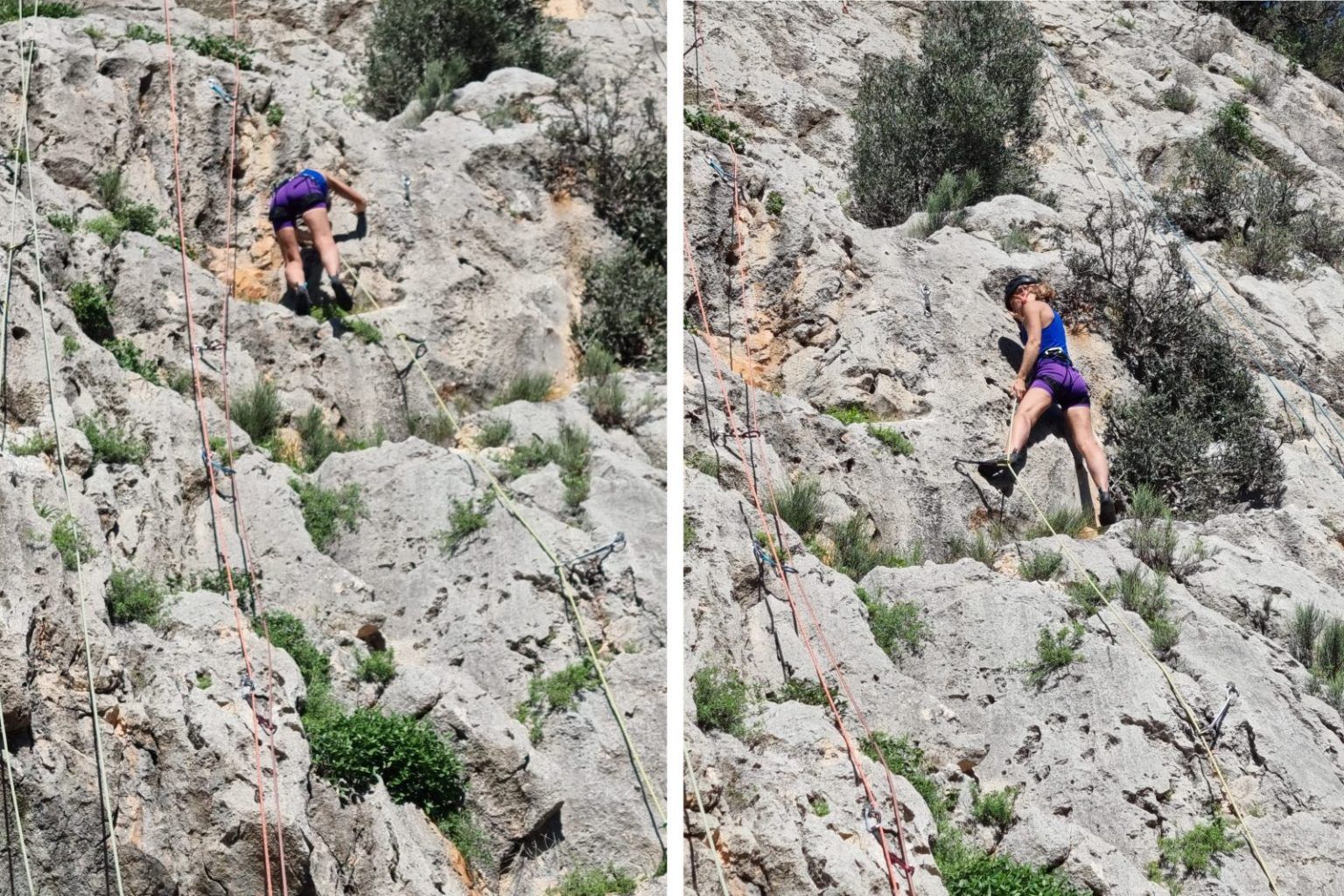
NOTE: It is not always safest to just stay close to the bolt. On many occasions it can be less safe to be directly above or close to the bolt. It is necessary to be aware of the terrain below you as you move and not just assume that staying close to the bolt will be enough to keep you safe.

Left: Risk involved: climber is climbing above a ledge to get to the bolt, risking falling onto it.
Right: Safe: climber is standing on the ledge while clipping the bolt, so she can´t fall onto it.


Summary

The steps of the climbing framework are: 

  • What is my destination; where do my feet need to be to clip the next bolt?
  • What is the least steep route for your feet to get to that destination?
  • Is the chosen route within what is an acceptable risk for you?

To accompany this article, please watch the Climbing Framework Video on the Rock & Sun YouTube channel.

This climbing framework has been developed by Rock and Sun (Trevor Massiah, MCI & Desiree Massiah-Verbeek, RCI) and was published in The Professional Mountaineer, December 2024.

New Routes at Pena Roja

The development of new routes in the Costa Blanca continues. Rock & Sun’s directors as well as main climbing instructors, Trevor and Desiree, share a passion for route development, so when they have a few days off, it is likely that they will be putting new routes up somewhere in the Jalon valley. They both love the creative process of spotting a new line of unclimbed rock. Often hidden behind trees and bushes – which Desiree takes care of. Then Trevor will set up a trad anchor from which they will toprope the newly exposed rock to see if there are any worthwhile climbs to be put up. If there are, then we have several trial runs on where best to place the bolts, after which Trevor gets the drill out to bolt the route. For more info on this process, read our earlier blog.

So far in 2023 this has led to 6 more sport climbing routes. So there are more and more climbs for you to have a go at, and there is something new every time you come back to the Costa Blanca for another climbing holiday.

We have kept the new route development quiet for a while, allowing us the time to climb these new lines with our clients, to get a better idea of the grades. But now we are ready to share with you the list of new climbs at Pena Roja in LLiber:

Route 1. and 2. are at the furthest left side of the ‘old side’ of the crag, in the guidebook called Lliber, Pena Roja ‘Antiguo’. The routes are immediately left of the existing route ‘Problema Izquierda’. Shade from 15.30pm onwards. They each have their own anchor. From left to right:

1. The Demands of Thor, F4, donated and named by Hannah and Ben Morgan-Gray

2. El Regalo, F4+, donated and named by Marta Kodin

The other 4 new routes are in ‘the tree sector’ at Pena Roja, in the guidebook called Alejandria-Izquierda. All 4 routes are left of Barney Rubble F6C. These climbs are in the shade until 12, and again after 16pm. From left to right:

3. La Jirafa, F4. Named by Rock & Sun (look around to see why we named it as such).

4. Rebecca, F5+, donated and named by Stuart Jamieson

5. Roger, F6A, donated and named by Daniel Graham

6. Bogota 2600, F6B+, donated and named by Mark Weenink

(all bolted by Rock & Sun: Trevor Massiah and Desiree Verbeek-Massiah)

Bogota 2600, 6B+


We have our eyes on a few other lines in the Jalon Valley and nearer the coast. So when we have another gap in our calendar, we will get started on those. Keep an eye out for more news. And get in touch if you would like to donate into the Rock & Sun bolt fund. If you donate £75 or more, you can name the route!

How to structure your climbing day

Strategy and a little bit of discipline are key ingredients to a successful day of climbing.

Far too often we see climbers arrive at the crag, full of enthusiasm and energy, with their goal for the day in mind. So keen to climb hard that day, that they don’t bother warming up. You can see them thinking (or sometimes we are lucky enough to overhear them say): “I think I can warm up on the route I finished on yesterday”, or “I don’t want to waste energy warming up and then be too tired to get the red point of my project”. So they start on something that is too hard for them to warm up on, which may lead to getting pumped, frustrated, or both.

Over the years we have realised that most climbers don’t think much about how to structure their climbing day. Some don’t realise how important warming up is. Some don’t know how to plan the day in such a way that they climb to the best of their ability by the end of it. And how are they supposed to know if nobody has given them advice on this?

This blog is all about how to structure your climbing day to get the best out of your body and mind.

Warm up.

Get your body and mind ready for the climbing day ahead. Climb a route that is very easy for you. A route that is well within your grade and don’t expect to fall off of or even get pumped. So you can just let the body move, not getting physically or mentally stressed. Climb it in your comfort zone the whole way up. Should things for some reason not feel easy for you during your first route: let go and sit on the rope.

Ego.

Our ego can get in the way of ourselves at this point. You don’t want to let go. You don’t want to ‘lose face’. You may even let the other climbers know “I climbed this without problems last time I did it”. You hold on and struggle on, your arms getting more and more pumped. You could of course have misread the guidebook and be on something harder than you intended.

Avoid Flash-Pump.

It’s called a flash-pump and it is very difficult to recover from. It may well stay with you all day. A warm up is what it is, a warm up. Get the blood pumping around your body with gentle movement like jogging or jumping. Lubricate the joints, activate the muscles. Don’t let your performance on the first or second climb affect your confidence. Don’t come to any conclusions about how you are going to climb that day based on how you climb the first few routes. If you felt clumsy, unfocused, tired, distracted or any other negative sensation, that is normal: you’re warming/waking yourself up. This is exactly why we warm up. To get that out of the way.

Fall.

We recommend to include some deliberate falls in your warm up routine. Letting go and practicing getting the landing right, releases the tension in the body and mind. Once we have experienced the apprehension before letting go and then the sensation of falling, we have reminded ourselves that we know how to fall and how to land. It relaxes you into the climbing. It stops you from over-gripping the handholds. It slows down your breathing. All of which help to increase the enjoyment (and performance) of your climbing. When doing fall practice on a regular basis, it has proven to be sufficient to do 2 or 3 Clip-and-Let-Go falls every time you go climbing. That hardly takes any time, and is extremely beneficial. Please read our blog “A fresh look at Fall Practice”.

Mileage.

Now we are ready for the main part of our climbing day.

As a rule of thumb, we aim to climb 6 routes in a day: 2 easy, 3 mid, 1 hard. And we rest at least 10 minutes in between every climb. This is increased to a 20 to 30 minute rest when we climbed to our max.

This rule of thumb can vary based on the aim for the day. If it is a day to do some climbing drills to improve your movement, then you would increase the volume. You would climb 10 routes, 8 of which easy where you can apply the drills, 1 mid where you incorporate the drills in the way you climb the route, and then 1  hard route where you can let the drills go out of the window and just try to climb the route as best you can but not worrying too much if you can’t hold your form.

If it’s a day of redpointing your project, then you may do 1 easy warm up route, 1 mid warm up route which includes some fall practice, and then move on to your chosen project. You could continue your warm up by bolt-to-bolting that route, or by stick-clipping your way up. Otherwise do something close to the grade of your project and if possible a similar style of climbing. Depending on how close you are to sending the route, the angle of the rock and how easy it is to bolt-to-bolt the route without falling into space and struggling to get back on: once you’ve reached the top, you could choose to toprope the route. And ego comes into play here again. Do no try to climb your project clean on toprope so you can say you’ve done it, or so you build confidence in your abilty to do it. It is smarter to hang or fall and repeat certain sections. Figure out the best sequences. Memorise the crux(es) of the route. And then your body is properly warmed up and you have all the knowledge in your head so you would then have a lead attempt.

Golden Standard.

Whether you are planning a day of ‘just going climbing’, onsighting, doing drills, or redpointing, we recommend that your climbing day meets the Golden Standard of 80:20. Where 80% of the session is practice and 20% is performance.

We wish you good luck in staying patient and in choosing discipline over ego, and hope you’ll experience the benefits of adding some structure to your climbing days. And don’t forget to have fun even when you fail.

Crag etiquette

Climbing is becoming ever more popular. Nowadays most climbers start indoors, in a bouldering gym or indoor climbing wall. And then at some point they will venture outside to do ‘the real thing’, climb on real rock. Sometimes we have seen this lead to friction between the behaviours of indoor and outdoor climbers. But how would they know about the unwritten rules of how to behave at a crag if nobody told them? In the old days most climbers were introduced to outdoor climbing by a friend who (knowingly or unknowingly) would have introduced them to the crag etiquette. As this is no longer the case for most climbers, we see it as our task as outdoor climbing instructors to do so.

There are some things that are good to know if you are making your first trip outdoors or if you are just unsure what is acceptable behaviour at the crag.

So let’s write down those ‘unwritten’ rules:

1. If your quickdraws are on a route but you’re resting, let someone else climb the route on your equipment.

2. Likewise, if you would like to climb a route that has someone else’s quickdraws on, ask if/when you could climb it. While climbing it, always check what you are clipping and that it is safe. I.e. are the draws in good condition, have they clipped the right bolts (this is especially important in Thailand when old bolts are next to new titanium glue-in bolts which should be the ones that are clipped).

3. If you are climbing in a large group, then offer another climber, who wants to climb a route your gear is on, a go when there is a gap in your group.

4. BUT, if you are the one to take up that offer, you are expected to be able to climb the route fairly quickly/efficiently. Not to hang all over it. Not to start bolt to bolting and red-pointing the route. It is also not considered ok to offer the route to others as this is not your call. You should ‘give’ the route back to the climbers who allowed you to climb it.

5. Be polite when asking for routes and when moving around each other at the crag. Remember that you are all there to enjoy the outdoors and the climbing. Don’t be afraid to ask others questions but do so nicely and possibly even start a conversation.

6. Don’t shout beta (guidance) without having asked if someone wants it. Most climbers want to figure out the moves themselves and would rather go the wrong way on a route, or use the wrong sequence instead of someone on the ground giving the beta. It is like someone telling you the plot of a movie before or while you’re watching it. Even when a climber has fallen off, and you know which holds they should use, you would still first ask whether they would like that bit of information or whether they want to figure it out for themselves.

7. Keep your stuff off the paths and try to avoid stepping on other people’s ropes, rope bags or mats.

8. Walk far away if you need the toilet and do not leave toilet paper behind, take it with you. Always carry a biodegradable plastic bag that you can put it in, which you can bin when you get back home. Further, leave no rubbish behind.

9. When you want to do something that will affect other climbers experience such as playing music or flying a drone, ask the other climbers if they are ok with that.

10. Last but not least, do not become the ‘crag police’ by telling people that certain holds are ‘out’. As long as people are being safe, having fun and being honest about what they did or didn’t manage to climb, there is no need to tell anyone that a certain hold does not belong to a route and therefore it is not the grade. Climbing outdoors does not have to be about climbing the route one specific way, with specific holds, as long as you are safe and having fun, that’s all that matters!


Climbing – What makes a grade?

Climbing grades are source of much debate. Who decides what the grade of a route is? What makes a route a certain grade? In this blog we will answer the frequently asked questions about sport climbing grades.

When climbers come down off a route, very often the first thing they say is something about the grade. “It is definitely not a 5+, at least a 6A”. Which happens a lot in the Costa Blanca. Or “I would love to ‘take the grade’ but that clearly it is not a 7A, more like an easy 6C, maybe even 6B+”, which is more common on Kalymnos.

In an attempt to not get sucked into a discussion on numbers and talk about the route itself, we ask the climber: Ok, but did you enjoy it? Was it a nice route? Did you climb it well? Were there some good moves on it? Because what’s in a grade? Are you climbing to ‘achieve’ or ‘chase’ a number? Or are you climbing because you enjoy climbing, want to solve the puzzle the rock presents to you, and climb a route in a way that feels right or nice to you?


Who decides what the grade is?

The grade is given to a route by the person who climbs the route first, its first ascensionist. In most but not all cases, this is the person (or: are the people) who bolted the route.

Routesetters with a larger frame of reference are more likely going to be ‘correct’ with their grading. How many years have they been climbing outdoors themselves? How many routes have they bolted before? Do they set the grade after their own ascent, or do they wait giving it a grade until they have seen other people climb it? Not all route setters have this opportunity but for us that is an important element of grading. We often get asked (or overhear other climbers having conversations about lower graded routes) “how can they tell the difference between a 5, 5+ and 6A, when they climb 7s all the time”? Well, because of years of climbing experience, and years of working with clients climbing those grades.

A team of climbers from the indoor climbing gym in Switzerland, called Griffig, have recently developed a new crag on Kalymnos, equally named Griffig. Everyone we spoke with who climbed at this crag says that the routes there are overgraded by at least 1, sometimes even 2 or 3 grades. This may be in line with what we have noticed on other occasions, when outdoor routes are set and graded by people who mainly climb indoors, it feels harder to them and as a result the routes are likely to be overgraded. Climbing rock not being their main surface to climb on, their footwork and routefinding skills may therefore not be as developed as amongst people who climb outdoors a lot. The ‘outdoor climber’ may find an easier way, resulting in the downgrading of the route. The overgrading of Griffig may also be explained by possibly them being in a rush to finish this crag before the masses of climbers would turn up leading them to give estimated grades on some of the routes. Or, another explanation could be – and this is something we were informed of recently by people who have been on a ‘Route Development Course’ – they are advised to inflate the grade so the route becomes popular. Well, that definitely did the trick for Griffig!

That brings us to the second part of the answer to “who decides what the grade is?”. After the routesetters or first ascensionists have graded a route, the vote goes to the outdoor climbing community. On websites such as UKClimbing climbers log the routes they have climbed, and leave their feedback on the grade they think it is. For a route graded 7B+ in the guidebook, you would get for instance 5 votes for “mid 7B+”, 11 votes “low 7B+”, 20 votes “high 7B”, 32 votes “mid 7B”, and 18 votes “low 7B”, then there would be a reasonable amount of doubt cast on the original grade and a route may get downgraded to 7B.

You can assume that for established routes that have been developed a few years ago and climbed by many people since that the grade is settled.


Which factors influence the grade?

The grade of a route serves as an indication of what difficulty to expect. It is not an exact science with a formula that can be applied to any route, in which case everyone applying that formula would get to the same grade as a result. However, there are of course objective things that route developers and climbers take into account when grading a route (not necessarily in order of importance):
1. The hardest move on the route. If you have a 32m route that is 5 all the way except for one 6B move, then it has to be graded 6B, otherwise a ‘5-climber’ would be deceived into thinking they would be able to climb the route. So a route has to be graded for its hardest move.
2. How many hard moves. The next thing to take into account is how many hard moves there are, more specifically, how many hard moves in a row. A route can be a ‘one move’ crux, or it can be very sustained, with many moves of a certain difficulty in a row, or it could have several cruxes instead of one, but with good rests in between. If a route has a one 6B move crux, it would be a 6B. Does it have a longer sequence of multiple 6B moves in a row, then the overall grade is likely going to be 6B+. Does a route have multiple 6B cruxes but for instance the angle of rock allows the climber to have good rests in between, then 6B remains the fair grade.
3. Length of the route. Similar but slightly different, is the length of the route. Is stamina needed for a 40m pitch or is it all over in 12m? A 12m 6B most likely has a harder technical crux than a 40m 6B of which the hardest move may be 6A+ but the extra grade is given to reflect that one has to be focused and on one’s feet for much longer.
4. The equation of the size of the holds, the spacing of the holds, the angle of the rock, and the friction of the rock. (read more below – Anecdote: size of holds)
5. The area where the route is. Every climbing area has its own history. Routes are graded in relation to existing routes. This means that within a climbing area, the grade gives an indication of how hard a route is compared to its neighbour. But often it does not work to compare one-on-one for routes in different areas. Some areas even become less popular because grades there are hard, and people allow themselves to be disappointed that they are not able to climb the grade they would climb elsewhere, and have to drop down a grade or two in this area. Climbers do like the ego-boost of climbing in areas where the grades are ‘softer’.


Anecdote: Size of holds. “The footholds are too small to call this a 5”. One of our clients said exactly this about Awesome (Pena Roja, Lliber) and it opened an interesting discussion, leading to a better understanding of the debate around grades. If what the client said is true, then how small can footholds be to give a route a certain grade? If there is one section on the route where the footholds are 1cm2, does that make the route a 7A? Just because you aren’t usually ‘forced’ to use small footholds on a 5? And if we were to grade routes for the size of the footholds, would there be a standard like in clothing where different cm’s equal different sizes XS/S/M? For instance foothold size >5cm2 = F3, 4-5 cm2 = F4, 3-4cm2 = F5, 2-3cm2 = F6, 1-2cm2 = F7, etc? We don’t think a system like that would hold up, as the difficulty of the move is an equation of the size of the holds, the spacing of the holds, the angle of the rock (A small foothold on a slab can be a great foothold), and the friction of the rock. Think of a crux sequence of a route, with a certain set of holds and the distance these are from each other, but then tilt the angle of rock a little bit, or reduce the friction, and it’s easy to understand that size alone doesn’t matter. It really is the overall technical difficulty of a move. And to come back to the route this client commented on, many of our clients who can climb F5 but can’t climb F6A, are able to stand on these small footholds, on this angle of rock, with its friction and the availability of handholds, and complete the climb.


Anecdote: Guidebook. Sometimes a route description in the guidebook will say “…, harder for short people”. This makes us laugh. Are we moving to a situation where a route is 6C for the strong, 6B for those with good technique, 6C+ for short people? Where does it end? The grade should refer to the route, not to the skills or physical characteristics of those who climb it. Which moves us onto..


Make the route the grade

Route reading and route finding are crucial as the grade refers to the easiest way to climb this route. Some routes are harder to read than others. Did you not climb it the easiest way, then you may have turned a 6C into a 6C+ or 7A. That’s why climbers shouldn’t really say much about the grade of a route when they have climbed it once. They should say something like “the way I climbed it, it felt like a … to me”. That way the climber acknowledges that they may not have gone the exact easiest way, may not have found all the hand- and footholds, may not have climbed it with the most efficient hand- and feet sequences.


Anecdote: New Beta. While bolt-to-bolting La Bella 7B at our local crag (Pena Roja, Lliber), having failed to execute the several ways I had seen other climbers do the crux moves, I hung on the rope – again. I thought I was never going to be able to do it this way. I looked around to see where the rock from this to the next bolt is less steep for my feet and then I noticed a line of feet going out left. And there are some handholds out left as well. I reckoned: It is less steep, the fall is clean, and this crux sequence ends on the same hold as the more common crux sequences. But later, while I was sending the route going left at the crux instead of going over the bulge, the locals sitting at the bottom of the crag said – loud enough for me to hear – “she’s going off route, it’s not 7B that way”. I am fine with that. I am happy to have found a nice and easier way to climb this route and if ‘my way’ is 7A+ then that’s great.
We will soon publish an article about Routefinding on our website or in a climbing magazine.


Grade for the onsight or for the redpoint?

Although that seems a simple either-or question, in reality the answer lies somewhere in the middle. Is it a route where the routefinding is obvious, a route that is easy to read? It is likely that people will find the crux hand- and footholds? Then a route is not much harder to onsight than it is to redpoint. But is it a route with several sequences that are difficult to see or figure out while onsighting, then it seems fair to us to grade for how hard the route feels without previous knowledge. It is commonly accepted that a redpoint is easier than an onsight. We think it is fair to grade for the onsight for routes that are within climbers’ onsighting capabilities. Within the climbing community, many climbers can onsight up to about F8A/+. When you go beyond that, it makes sense to grade for the redpoint as there aren’t many climbers attempting to onsight those routes.

Anecdote: Grace. There’s a route called Grace (7A) at Chong Phli in Thailand. The local climbers for years have been saying that it is actually only a 6C+. But we agree with its original grade, having climbed the route with many of our clients and therefore having been able to use them as our frame of reference. Grace is a rather sustained route with multiple cruxes. If you don’t find the best holds, or don’t climb the best sequence in either of these sections, it certainly feels harder (less stable on the feet, more relying on the arms) than it does to the local climbers who spend no time looking for holds or working out sequences. Once a climber has bolt-to-bolted and redpointed Grace, and quite literally is able to climb it Grace-fully, it could feel like a 6C+. But to get to that stage, a lot of effort needs to be put in, which we would argue justifies it being graded 7A. Onsight Grace feels more like 7A+. As a redpoint it could be a 6C+.


Final remarks

A grade in a guidebook is quite literally a guidance. The purpose of grading routes is to give the climber an idea of what is available to them from one crag to the next, and to choose the climbing experience they would like to have. Climbers roughly know their warm up grade, their onsight grade, and their redpoint grade. When going to a new area, jump on a couple of easy route first to see how the grading fits with other climbing areas you have been to, so you can pick the right challenge for yourself on that given climbing day.
Of course, talk about and discuss grades as much you like but our advice is: do not let it become your main focus point or main aim. Don’t allow yourself to be disappointed by a grade or it being the only thing you have to say about a climb. Don’t reduce a climb to its number. Enjoy the route. Enjoy solving the puzzle it presents you. Enjoy the moves. Enjoy your climbing.


*For reference to those who climb in areas that don’t use the French grading of sport routes, please see below the Climbing Grade Conversion Table made by Rockfax*

A fresh look at fall practice

Being comfortable with falling is crucial in order for people to be coached effectively. Being fully focused on the climbing itself without being overly fearful of falling leads to better quality practice and higher performance. Confidence in assessing the outcome of falling and knowing how to react also creates a safer climber. However, most climbers we work with either never practice falling, only practice indoors or do it so infrequently that it’s ineffective. Here we look at ways of making regular fall practice more accessible, fun even.

Why Fall Practice

Confidence in falling increases the chance of climbers trying what they consider to be low-percentage moves (see Figure 1 – orange arrows). Ultimately leading to them climbing closer to their potential.

Many climbers take an alternative route. By practicing moves, becoming technically proficient or fitter and stronger, climbers turn low-percentage moves into high-percentage ones (blue arrows), thereby reducing the likelihood of falling.

 Staying within the comfort zone

Most of our clients have experienced fall practice at their local gym, only few have done so outside. The practice usually consists of taking a leader fall by jumping off with the feet above the last clip. Although intended to reduce the fear and to practice reacting correctly while falling and landing, for most people this is an unpleasant experience with few left feeling keen on repeating the experience regularly.

In recent years we have learned that it is possible to achieve the desired result without taking falls with the feet above the protection. It is important to work within the climber’s comfort zone, and gently push the edge of that a little further. Comfort zones differ from person to person, and can change on a daily basis. Explicitly aim to start with an exercise well inside the climber’s comfort zone and not push too far or too quickly as that is likely to result in an uncomfortable experience that they may then not want to repeat.


Some Practical Considerations

Of course it is not always safe to fall and falling is not simply a case of letting gravity take over. There are many things the climber and belayer can do to reduce the risk of injury. Safety when climbing involves dynamic or continual risk assessment. We all have different levels of spatial awareness and understanding of physics. For many it is important to experience falling regularly and in different situations to increase the ability to assess risk and act accordingly. Without this climbers may either be putting themselves at risk or be terrified when the consequences of a fall present little risk. With experience climbers are better able to assess how far they will fall and whether they are likely to come into contact with the ground, ledges, or other objects during the fall. Where it is not safe to fall, it may be appropriate not to commit to the moves, but reach for the clip stick, down climb or lower to the ground.

Executing a leader fall:

  • Look down at feet, land with soles of the feet.
  • For stability, keep feet shoulder width apart.
  • Cushion the landing by bending the knees as feet touch the rock
  • Grab the rope near the knot to avoid falling upside down
Climber doing “Clip and Let Go”-exercise to practice falling

How to do Fall Practice

There are several stages to start the process of fall practice. It is important not to move from each stage unless the climber has become comfortable with the exercise. Some climbers may not move beyond stage 1 – but can still experience huge benefits, some climbers may start at stage 5.

  1. On toprope the climber simply practices bending the legs and pushing off, then bending the knees to cushion the landing as they swing back in with the soles of their feet. Increase the distance by pushing off harder and harder. When doing fall practice on toprope it is beneficial for the climber not to hold onto the rope but relax the arms.
  2. The climber walks or runs sideways until they are comfortable with the inevitable pendulum this will create. Then move on to pushing out with their legs (as in the previous exercise) at the end of the pendulum creating a swing across the wall. This improves their skill of managing sideways falls and landings. We also aim to achieve a sense of fun and being more confident in their ability to manage a fall when sideways to the protection.
  3. Toprope falls; on reaching each quickdraw, the climber touches it and jumps off immediately. The process is repeated at each quickdraw. The aim is to minimize the hesitation and assess how relaxed the climber is. The belayer needs to assess the appropriate amount of slack in the system from a safety perspective. As confidence increases the belayer can slowly increase the amount of slack in the system. Often simply announcing that there will be more slack, (even with the slack not actually there) will elicit a nervous response: a hesitation to let go upon touching the quickdraw, stiffening in the body, hands moving towards the rope, and/or an audible shriek while falling.
  4. This stage is best done on lead and the climber should be at least 2 metres below the designated clipped quickdraw (with a safe fall-zone, ideally slightly overhanging and an appropriate distance up the route). Climber needs to choose a climbing position with 4 points of contact, and easy enough to hold so the exercise can be repeated a number of times. The climber should take three deep breaths, and on the 3rd breath out, push up from the legs, touch the rock as if going for a handhold and release. We are aiming for the climber to actively go for the move and then feel, look and even sound relaxed on the fall. The first falls should be with the minimum amount of slack. Once the climber is comfortable with that fall, increase the length of the fall by introducing more slack or dynamic belaying. This process can be repeated with the climber’s chin being above the quickdraw. Not having the rope in view is usually enough to elicit a greater stress response. This exercise could finish with the climber taking lead falls with the feet above the quickdraw. We find this to be rarely necessary. This exercise is particularly useful for breaking the cycle of freezing and eventually letting go which leader fall practice often promotes.
  5. On lead, the climber clips each quickdraw, and then lets go. Variations in the fall are achieved by the belayer having more or less slack in the system – providing a soft catch where appropriate – and by the fact that naturally some clipping positions will be sideways to the protection. For this exercise it is obviously far more important that the belayer is skilled. This process carries a greater degree of risk. It is necessary to designate a starting clip from where to start the exercise, which may be the second or third quickdraw. From a safety perspective it is useful in this exercise for the climber to pause a second before letting go to check the clip has been made.

As mentioned, fall practice can start at any of these stages. Before moving to the next stage, ask the climber to give feedback and assess their body language. Some signs of fear or nerves: hesitation in letting go, stiffness or tension in the body especially the arms, or audible shriek while falling. In this form of ‘immersion therapy’ it is important to recognise when the climber is reaching their limit. The aim is to keep the sessions positive, even fun! Only move on to the next stage when both climber and coach agree that the climber is ready.

Climber doing “Clip and Let Go”-exercise to practice falling

Final Words

Our experience is that most climbers don’t even want to think about falling, let alone practice it. Others say they are not frightened of falling and therefore don’t need fall practice, despite displaying the obvious signs of fear. Without regularly experiencing or practicing falling, any original fear or apprehension tends to creep back in.

There is more to falling than just letting go.

With this fresh approach to fall practice, falling becomes something to be incorporated into every session, rather than being a stand-alone session. It also provides the climber with safe non-intimidating options that they are likely to continually practice. We have been genuinely surprised at having some of our most fearful clients actually requesting some form of fall practice at the start of a days climbing.

Published in Professional Mountaineer, Summer 2021. Words and photos by Trevor & Desiree Massiah

New Routing

If you follow Rock & Sun on Facebook, Instagram or via our Newsletter, you would have seen a few posts this year about the new routes we developed in the Costa Blanca during the Corona pandemic. Here we will describe what it entails to make them, what we love about new-routing, plus we’ll give the overview of all the new routes as most of them were developed just after the new Costa Blanca guidebook by Roberto Lopez was published. We also aim to answer the questions you’ve been asking us about developing new routes. If you have more questions after reading this blog, please send us a message and we will add it to this blog.

New-routing during Covid-19

International borders being closed for tourists for most of the time between March 2020 and May 2021 meant that we had a lot of time on our hands in the last year or so. Once the initial and very strict lockdown in Spain ended and we were slowly gaining more freedom again, we at first felt it could be considered too ‘frivolent’ to start climbing for fun again. But we considered going to the crag to create new climbs a justified reason to go to the crag. The first routes we started to work on were the 4 routes ‘in the trees’ in sector Alejandria of Pena Roja (see the full overview of new routes at the bottom of this blog). Trev had his eye on this sector mainly because of the easy angled rock and the fact that it is protected from the sun by the trees. If we could create some routes here, that would allow us to climb at Pena Roja all day; starting in Alejandria-riverbed in the morning, then move into the trees, and finish the day at the original wall of Pena Roja.

What is your motivation for developing routes?

A question we get asked quite regularly, as most climbers ‘just’ climb and never put up a route in their whole life. Routesetters can be quite invisible, and unless you get to see someone developing a route, you may never really think about how and why those bolts got there.

There are several reasons why we like to get involved in bolting routes. One is because we are well aware of the fact that as Rock & Sun we use the Costa Blanca for our Sport Climbing Holidays and Performance Coaching Courses. We climb routes that have been equipped by others, we bring more climbers to this area. We therefore find it important to do something back. Not only by maintaining existing routes or sectors (we for instance replaced 10 anchors at Sierra de Toix Oeste with titanium glue in anchors), but also by creating more routes. This will give the locals something new to climb, and it will give climbers from other areas something to come back to the Costa Blanca for, and it means that on busy days at popular crags, people can spread over a greater number of routes without having to wait for one another.

Another important reason to develop new routes is so that when we are working with our groups, we can organise our climbing days in a different way and thereby offer our clients better climbing experiences. By for instance creating routes that are in the shade around midday, it means that when it’s hot we can climb in the shade all day, moving from one sector to the next, instead of having to go back to the villa for a two or three hour break before heading out to the crag again. And it also means our regular clients will have something new to try on their next trip. Finally, the routes we set tend to lend themselves really well for climbing coaching; they are good routes to practice route-finding and/or work on technical movement patterns.

The whole creative process from spotting to bolting new lines is our third motivation. We all have a different creative outlet; some of us sing, make music, love cooking, painting or making furniture. For us, it is new routing that ‘ticks us’. Trevor is naturally looking for new route potential at any crag we go to, even at any crag or piece of rock we drive past. He is always spotting natural lines or striking features that would be amazing to climb. Those of which that are on shady crags, with a potential grade range from 4s to 6s are the top of our list to have a closer look at and decide to start working on. What Desiree loves most about this creative process, are first, the uniqueness of climbing an unclimbed piece of rock and the freedom to decide where it climbs best, and second, the removing of loose rock, vegetation and mud, behind which you often find beautiful handholds.

These cleaning activities naturally lead us to our final motivation of new-routing: it is a great way to get fit. After 2,5 months in total lockdown, having drunk and eaten more than we could burn off, we had some kilos to lose and muscles to regain. Hanging in the harness all day, jumarring up the fixed line, using a crow-bar to get body-size blocks of rock off, hammering other loose rock off, drilling and brushing provides a quite intense full-body workout.

The rock scars as well as rocks at base of the crag show the amount of rock we removed (sector Estado de Alarma, Cuarentena, Corona)

Do you need permission or a qualification to make new routes?

There is no qualification for route-setting. It is a skill that is often passed on from an experienced route-setter to an ‘assistant’ to learn all the ins and outs involved with doing a good job at it.

Whether permission is needed completely depends on where we want to develop new routes. If the land is privately owned then of course we’d need permission from the land owner. As it happens though, on more than once occasion it has been the other way around, and Trevor has been asked if he would please come to have a look at a limestone wall and develop routes there. These instances were in Thailand, where the owners see the potential of building bungalows and a restaurant to accommodate the climbers, once the routes have been developed. A win-win situation.

If the crag is on public land, we ask around among local climbers to see if permission would be needed from the forestry commission and/or from the municipality. For the past year we have wanted to start developing this untouched, north-facing crag, not far from where we live. We explored it on a few occasions and see great potential, but after talking to some local climbers we decided that now is not the right time to ask permission from the local government. So we will save that crag for another time in the future.

On existing crags, we use the following logic. If it is an established crag where there haven’t been new additions for a while, then we assume that the original route developers have finished the lines that they want to put up. And that they would not be against us developing more routes. Most local developers are, A: not interested in removing tons of loose rock or vegetation, and are B: not interested in bolting low 6s, 5s or 4s. Whereas those grades are of great interest to us. The routes at the Alejandria sector in the trees for example, from Estado de Alarma till Distanciamiento Social, took a lot of effort to get cleaned. We spent multiple days up there with a crowbar and lump hammer to make this area safe for climbing. And possibly more surprisingly, the sector at Alcalali from Artmosphere till The Baker was never developed before because the rock was invisible behind the trees and bushes that were growing on its ledges. Once we cut those down, a beautiful compact slab appeared with four striking lines. We opened this sector in November 2020, and with Alcalali being the perfect winter crag in the Costa Blanca, these routes were popular right from the start.

Finally, if the crag we have spotted a line on is still in development, which was the case for Murlali, we ask the people who are bolting there whether they are planning to bolt the line that we have seen. For “Cuando termine el cierre” we were given permission to go ahead and develop that route. The last thing you want of course when you are aiming to contribute to a climbing area is to upset the other developers and climbers in that area.

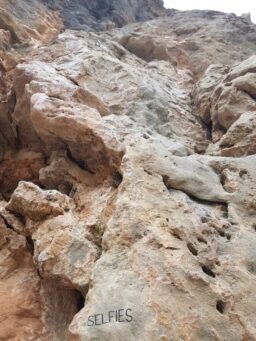
Selfies (5) was donated and named by Ross and Ness Self

How much does a route cost?

This depends on the materials used. Titanium bolts that need to be glued in with a special waterproof glue (Hilti RE500, see our blog on placing titanium bolts) are more expensive than 12mm expansion bolts, which are more expensive than 10mm expansion bolts. And expansion bolts come in different alloys that vary in cost and durability. It also depends on the length of the route, or more precisely, how many bolts are needed to protect the route. Besides the material going into the route itself, there are the associated costs of the tools and protective equipment: a cordless battery-powered hammer drill (we use the Hilti Te4-A22), drill bits, ropes, saws, brushes, etc.

We estimate that on average a route costs £120.

Is there a bolt fund? How can I contribute?

In the Costa Blanca there is no bolt fund. We feel it is our obligation to contribute to the maintenance and development of this area and have been investing in it using our own funds. We do of course welcome contributions and have set up a donation page in the Rock & Sun Shop. For a £75 donation you get to name the route. Climbers visiting us in the Costa Blanca can contribute by buying a Rock & Sun t-shirt or renting our climbing shoes, harnesses, or helmets; all this income goes towards route development and route maintenance in the Costa Blanca.

How many days does it take to make a route?

On average it takes 2 days to develop a route. This however completely depends on whether it is the first route on a sector and we need to get access to the top of the crag, or whether we are creating a new route next to an existing one, in which case we can simply traverse across from the existing anchor. Besides the ease or difficulty of getting access to the top, the time it takes to make a new line also depends on the amount of vegetation and loose rock that needs to be removed.

Trevor on the first ascent of Tiger Balm (6A+)

What is the process of making a new route?

First we need access to the top of the crag. Sometimes it is possible to walk to the top of crag and set up a temporary anchor there, using trees and or trad gear. When that is not possible and it is also not possible to traverse across from an existing anchor, then Trevor will trad climb up a route from the ground and make a trad anchor at the top. This anchor is not necessarily in the spot where the final anchor will be but can be used during the routesetting process. Once a line is fixed, we can haul the drill up and drill 12mm holes to place Petzl removable bolts and take out the trad gear.

Using the temporary anchor, we set up a toprope. Both of us climb the ‘line’ at least twice. Do we choose similar ways to climb this unclimbed piece of rock? Does it go where we thought it would when we were looking at it from the ground? Is it a worthwhile route that we can make safe and fun to climb?

Once agreed on where the route goes (more or less) we climb it again to mark where the bolts go. This is a very interactive process between climber and belayer, and a lot of thought goes into it. Ultimately we want the bolts to 1) be in solid rock, 2) protect the climbing, 3) be in comfortable clipping positions for short and tall people, 4) allow the rope to run more or less in a straight line. Other considerations are that the bolt should not interfere with hand-or footholds, that the quickdraw should be hanging ‘free’ in the bolt (not pressed against or over the rock below the bolt). We both climb it several times, marking, erasing and re-marking bolts until we are happy that the bolts are marked where we would like them to be.

Depending on the amount of vegetation and loose rock, the route is either being cleaned before marking the bolts – if there is a lot of cleaning to be done, or afterwards – if the cleaning is more or less ‘cosmetic’. Desiree usually does the cleaning jumarring up a fixed line, instead of a toprope, so we can both work at the same time. Trevor can for instance be on a fixed line next to it and drill the bolts on the next route.

Trevor sometimes starts with the first bolt from the ground, working his way up to the anchor. Other times he starts at the top and works his way down. Before drilling the hole, the quality of the rock is assessed once again with the hammer to make sure it is in good quality rock. It is not always possible to put the bolt exactly where you would like it to be.

Once the bolts have been placed, we do a final clean of the route: blow off the drill dust, brushing the holds. Sometimes we reinforce holds with glue, to make the route safer (we did this for Cuarentena and Corona), or to make sure that the crux hold won’t break off (we did this on Tiger Balm).

Then one of us gets the privilege of the official “first ascent”. Climbing the route on lead for the first time, helps us to get a better idea of what the grade might be.

Trevor on the first ascent of Golden Jugs (6A)

Final Words

The good thing the Pandemic has brought us, is time. It has been great to invest in the climbing in the Costa Blanca by developing new lines. We love the process from spotting a line on the rock, to cleaning the vegetation and loose rock, to deciding where the bolts should be, and having the first ascent.

That is when the next bit of the fun starts – introducing the route to other climbers and watching them climb it. Do they go ‘the right’ way? Do they more or less get the difficulty they were expecting based on the grade we gave it? And most of all, are they enjoying it?

As the Pandemic is nearing its end, and international travel being allowed again, we are very much looking forward to our clients returning and allowing them to have a variety of new climbing experiences.


Full Overview of routes bolted by Trevor and Desiree during the Covid-19 Pandemic[i]

 CragRoute NameGradeDonated and named by (if applicable)Finished around
1Alejandria (in the trees) – Pena Roja, LLiberBarney Rubble6cAug 2020
2Yabba Dabba Doo !!!6cApril 2021
3The Flintstones6cAug 2020
4Estado de Alarma6bJune 2020
5Cuarentena4-5+June 2020
6Corona4+June 2020
7Distanciamiento Social6a+June 2020
8Alejandria (riverbed) – Pena Roja, LLiberDenise Denise4June 2020
9Awesome5+June 2020
10Rainbow Feet6b+Feb 2021
11Golden Jugs6aAlan BrittonFeb 2021
12Voltarol6cMarch 2021
13Tiger Balm6a+Feb 2021
14Selfies5Ross and Vanessa SelfFeb 2021
15Take is not a safe word6b+Blanka NoriMarch 2021
16AlcalaliEpidemiology5Paul CookeJan 2021
17Viva Colombia5+Mark WeeninkJan 2021
18Artmosphere6a+Rianne VerbeekNov 2020
19Rocky6aSteve CoxNov 2020
20Gene6b+Nov 2020
21The Baker6a+Nov 2020
22MurlaliBen & Jerry’s6cMark HaworthFeb 2021
23Cuando Termine el Cierre6c/+Stewart RobertsonFeb 2021


[i] Multiple routes at the same crag are described from left to right when facing the crag

*Alcalali and Murlali are temporarily closed for climbing due to a discovery of ancient cave paintings. Once these have been analysed and protected by the researchers of Alicante University we expect these crags to be opened up to climbers again.*

Placing Trad Gear Between Bolts

Placing trad gear between bolts can be an effective solution when struggling to find easy well-bolted routes for clients. Low grade routes can often be the worst to fall on due to the easy angled nature of the rock, making it far less likely that falls will be clean. Let’s face it, how often do we struggle to find well-bolted easy warm up routes? Bolts on these routes are often placed where the climbing is a little more difficult and the possibility of falling possible. This can often lead to long gaps where the first ascensionist may find it hard to imagine anyone falling but the consequences may prove to be serious. This can result in intimidating or terrifying first leads for clients.

Firstly, let’s look another option available to us before we look at the advantages of placing trad gear.

Using a sling or an alpine draw on the bolt can work well when the distance between bolts is not too long. This will bring the clipping position closer to the previous bolt (or ground) and is sometimes all that is necessary. When using this option, it is important to consider that we may have now created an unreasonable or unsafe gap to the next bolt. This can easily be solved by also clipping a standard length quickdraw onto the same bolt. This usually becomes essential when using a full-length sling to extend. Something that we need to be aware of though when using this method is that a high percentage of clients forget to clip the standard draw. This happens surprisingly frequently!

I’ve found that once people have clipped whatever is on the bolt, they tend to then focus on the next bolt. They will not necessarily pay attention to what else is on it when they get to within reach of the bolt itself. If working with a small group where it is possible to watch each climber closely enough to remind them as they pass the bolts, then this is fine – as long as they hear you and process your words. If working in larger groups where close supervision is not possible it can however present a real danger. For a number of reasons climbers may not be taking into account the distance between clips or be aware of the consequences of the fall (this can be even more problematic if any of these extended clips are out of view). When this occurs, we may have fixed one problem but created another.

It can be helpful to use a brightly coloured quickdraw that will stand out from the sling when you are using this method. A clear briefing on how to manage these clips is necessary but even then, the expectation should be that the distractions involved while climbing will cause a good percentage to forget. Therefore, I prefer to minimise the use of this technique if possible.

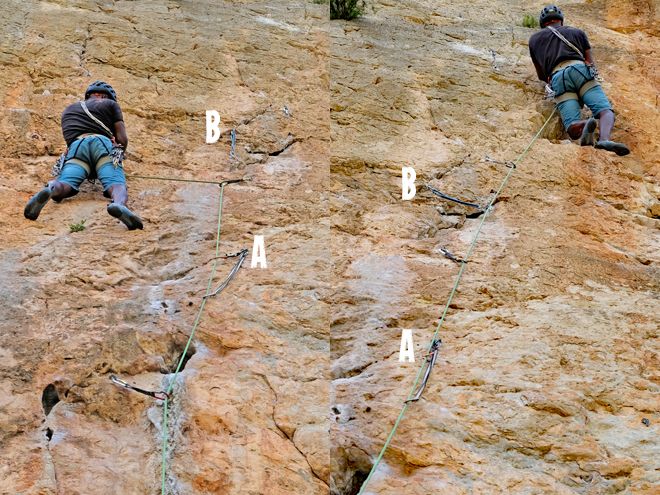
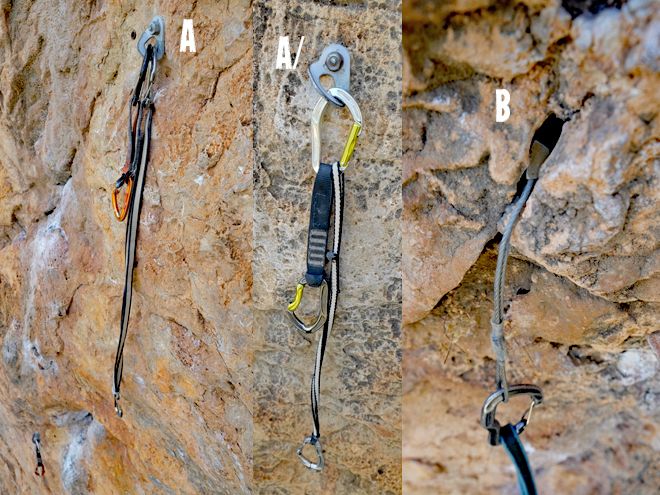
A, A/ Two ways of reducing distance between bolts.
B Trad gear in between bolts

So, let’s look at the advantages of placing trad gear for your clients to clip:

  • Reduces the distance between clips: this can minimize the chances of sustaining injury when falling. It can also help make the experience of leading less stressful and more enjoyable – especially for nervous leaders, which in turn can build confidence in being on the sharp end.
  • Less opportunity for getting the rope behind their legs and risk falling upside down. I try to create a clipping position every time the foot is a little below the last clip. Rope awareness is often hard for people to think about – let alone fully understand – until after they have become comfortable leading.
  • More clipping practice.
  • Back-clipping mistakes become less of a factor when it’s not the case that each clip is crucial.
  • It can act as a gateway or introduction to trad climbing as people have the chance to see how trad gear works in practice, and often take an interest in how it works. They can become confident in the safety of well-placed gear.


Considerations when placing trad gear on sport routes

When adding trad gear between bolts, there are a few considerations to keep in mind:

  • It is best to place any extra gear on lead as the clipping positions and falls are easier to assess than when lowering. It is important to assess the consequences of the trad gear failing and the next piece or bolt holding the fall.
  • Gear needs to be bomb proof. Remember that you won’t have an inexperienced second trying to fiddle it out, so you can ‘weld’ them in and remove them yourself if necessary.
  • Pieces need to be placed with greater consideration for an outward pull. As lowering tends to have a greater outward pull than falling on a piece, use longer quickdraws than you might normally.
  • Consider keeping the first bolt clipped for the leader as this will reduce outward pull on any trad gear.
  • If multiple people are leading the same route, ask the climber to lower past each trad piece and while at head height unclip it from the rope carefully. It is best to not have the trad gear clipped if the next person will top rope the route – this reduces the risk of them forgetting to unclip the gear as they climb past which might dislodge it, making it unsafe for subsequent leads.
  • With the clips being closer together, climbers need to be reminded of the increased risk of “Z” clipping which also has the risk of dislodging gear.
  • Resting on trad gear should to be discouraged. People are used to resting on bolts while as close to them as possible, maybe even holding onto the draw while leaning back. When clients want to rest on trad gear, I encourage them to fall, to push on to the next bolt, or to climb down a few moves to rest on the bolt below.


Disadvantages of placing trad gear

The considerations listed above should help to ensure that the trad gear is well placed from the start till the end of the session to protect our clients and/or to give them a confidence boost. I will re-climb routes to check placements if I’m not sure. As well as the advantages of adding trad gear to sport routes, there are also some downsides:

  • Some people feel like they are cheating, not accepting the challenge of the route. I like to remind them that they are sport climbing. It is completely arbitrary what experience the route setter creates. One person might prefer to produce well bolted friendly experiences and another person develops routes that can feel more terrifying than a grit E5! Often the bolts on easy routes are spaced to save money, not because of some sort of ethical or adventurous approach. This can also be the case on older routes where the first ascensionist attempted to justify placing bolts by keeping things a little spicy! As the first ascent is rarely an onsight, this can be somewhat unfair for those that come after.
  • The extra protection will undoubtedly encourage some climbers to lead routes they would otherwise have declined. Failure of trad gear to hold a fall that results in injury could then be problematic from a liability standpoint. Clients should have accepted the risks involved with sport climbing but may have little or no understanding of trad climbing.
  • It is of course important to remember that independent climbers may also want to climb the routes that you have equipped. They may or may not appreciate the extra gear that you have placed? It is always advisable to explain the process and possible risks as you would to your clients.


Final words

Adding trad gear can serve as a psychological confidence booster and increases the safety of the client. I believe that with all considerations taken into account, the pros outweigh the cons by a large margin, so adding trad gear to sport routes has become standard practice for our team of coaches when climbing routes that are not adequately protected.