
Tag: Onsighting

Navigation for Rock Climbing

In the previous blog ‘A Climbing Framework for Sport Climbing’ we looked at a framework as an aid to better decision making for leading. The framework included a simple formula for navigating between the bolts: 

Navigate only for the feet, choose hand holds based on the direction you want your feet to travel. Go where it is less steep overall for the feet but be sure to risk assess your chosen route before committing to it. 

In this blog ‘Navigation for Rock Climbing’ we are going to provide a deeper explanation of the rationale behind it because, although it sounds simple, it’s a bit like learning to use contour lines when map reading. It takes some practice before the information jumps out at you, and you also need to fully understand and trust the process to commit to practising it.

Find -and climb- the easiest way

Apart from safety and coaching efficient movement, route-finding or navigation has become a primary focus when coaching outside. The fundamental concepts of moving more efficiently are usually easily understood as there is immediate feedback of the climbing feeling easier, the upper body having to work less, and the arms not getting as tired. On a Coaching Course, which is 5 climbing days filled with video analysis, theory and drills and exercises to understand and practise efficient movement, climbers improve on average two grades in one week. With navigation, people can take a long time to understand and engage in the process, especially because seeing the change in angles is difficult at first and it requires climbing routes in several different (steeper and less steep) ways to compare and get the evidence. Plus, after the week of climbing outdoors, this skill can not continue to be practised indoors. In our experience more than 90% of the climbers that we work with climb at least 2 grades harder indoors than on rock. People were still way off their true potential despite the obvious improvements in their movement skills. So, we realised we needed to put a greater emphasis on route finding. However well you move on the rock and whatever strength and fitness gains you make, none of it will fully translate to your maximum grade if a good percentage of the time you are navigating the “wrong” (harder) way. It is possible to argue of course that there is no wrong or right way as we have the freedom to choose where or how we climb each route, but when coaching we are being asked to help people climb to their full potential, so this involves both technique and navigation (climbing the route the easiest way and doing the most efficient moves). 

Sandbag? Or did you not find the easiest route?

We were fortunate enough to have a lot of spare time on our hands during the pandemic and chose to spend much of it developing our local crags. Our motivation with new routes has been to bolt at a useful grade for coaching on. We noticed quickly that many local and independent climbers thought many of our routes were sandbags (much harder than anticipated). Fortunately, we are often able to watch these routes being climbed while working with our groups. We have been surprised or even shocked at some of the route-finding choices and fully understand why the routes were thought to be under graded. I couldn’t resist trying to climb a 6a+ that we had bolted the way we had seen several climbers try it. Climbed this way I figure it would be at least 7b!

While observing and discussing with our clients how they determine where a route goes, it is apparent that most climbers use things that are not necessarily helpful such as chalk, handholds, the bolts or an arbitrary distance that they are allowed to climb left or right of the bolts. Therefore, we have tried to come up with a dependable way to assist with route-finding choices rather than just beta which is only useful on that one route. We find ourselves constantly repeating the mantra of ‘look at your feet and follow the least steep way to your destination’. This is literally what we always start with when climbing for ourselves and we find it hard to think of routes that do not fit with this approach. 

Climbing is problem-solving

Climbing is a problem-solving exercise. The first three parts of the problem are cerebral not physical:

  1. Reading the rock/navigating. Where does the route go?
  2. Risk management. Is where I want to go reasonably safe?
  3. What sequence of holds and movement is most efficient.

Only then do we get to do the physical bit: moving in the chosen direction in the most efficient way.

The other route does not exist

We often hear questions like ‘isn’t that the other route’ or ‘am I allowed to go that way or is that cheating?’. These questions often refer to ‘will I have climbed the grade or made it easier?’. We find this interesting, as routes are graded for the easiest way, and the whole point is to find that easiest way. If there is a safe easy way to do the route, then that solution is the grade. 

We’d like to emphasise that while route finding any bolts on other routes can be ignored. When bolted routes are close together, one of the routes was there first so all the holds on that section of rock were part of that route. It does not make sense that when a new route gets bolted that some of those holds are then considered as no longer ‘in’ because they are now ´on the other route´. We often find ourselves saying ´the other route does not exist´ and ´the other bolts do not exist´. You are climbing your route, with your line of bolts there to keep you safe. So you go where it is easiest, least steep and safe for your route. The only route that exists is the one you´re climbing at that moment. Granted, the rock being the surface we climb on, sections of it can be climbed by multiple routes. Multiple routes may use the same section of rock. 

Besides the point we´re making that you can´t be ´on the other route´, there is also no such thing as being ´off (your) route´, unless your chosen route is unsafe, in order words: unless the bolt does not keep you safe on your chosen route.

When the hardest routes in the world are climbed the first ascensionist might be searching for the new hardest line, but they are not going to avoid an easier section then claim to have done the hardest route and not expect it to get downgraded pretty quickly! If you are confident in your ability to assess the risk, you are free to move as far left or right of the bolts as you like: climbing is an individual experience. From a coaching perspective though someone is paying for information on how to make climbing easier, how to become a better climber and reach their full potential. We find that helping them improve their navigational abilities is essential. 

Historical context to Navigation

People often find it easier to understand our approach when given some historical context of the development of the sport. From hill walking to mountaineering to rock climbing and bouldering. 

When walking uphill we tend to take smaller or shorter strides as the terrain steepens. We may also zig zag to reduce the incline and reduce physical effort. We will literally navigate our way around any steeper difficult sections. Mountaineers will be drawn to steeper harder sections seeking out more adventure, wondering if the summit can be reached via this harder steeper approach. Mountains can of course offer many different routes and challenges, some of which maybe offering too great a risk without the ability to climb sections of technical cliff faces and ridges. Early mountaineering routes would avoid these features, as without the necessary skill and equipment they were not yet possible. 

As mountaineering routes became more technical, taking on steeper more challenging terrain, it became necessary for mountaineers to be more skilled at climbing rock faces. This led to mountain climbers practising these skills on outcrops and cliffs in preparation for climbing in the alps and the greater ranges beyond Europe. This is how traditional climbing was born. Sport climbing followed and then of course the obvious evolution to bouldering -practising hard moves close to the ground as a way of improving performance on roped climbs. These facets of mountaineering are now considered disciplines in their own right. Looking back at each can help in the understanding of how our approach to climbing has been shaped.

Some boulderers will never tie onto a rope. Some rock climbers will never climb a mountain. The thing that they all have in common is that they all fundamentally begin with at first avoiding the most difficult challenges and then gradually seeking out those more difficult climbs. They all also involve navigation but with each one in turn the navigation becomes more subtle nuanced and therefore easier to overlook.

Summary

Navigating the terrain that we move on is the main purpose of all mountaineering disciplines. With a greater number of climbers bouldering (deliberately seeking out hard moves) and/or mainly climbing indoors where route-finding skills cannot be developed or practised, we see teaching climbers how to navigate the rockface and find the easiest safe way as the task of outdoor climbing coaches.

Video

To accompany this article, please watch the Navigation for Rock Climbing-video on the Rock & Sun YouTube channel.

This navigation tool for rock climbing has been developed by Rock and Sun (Trevor Massiah, MCI & Desiree Massiah-Verbeek, RCI) and was published in The Professional Mountaineer, March 2025.

A climbing framework for sport climbing

A climbing framework for sport climbing

This is a practical step-by-step checklist of how to approach the assessing and climbing of a sport route safely and efficiently. Everything else you do when climbing should come after and be structured around this. 

Let’s first assume that we are able to determine that the route looks safe in terms of loose rock and that the bolts are well placed and in good condition. 

Climbing is a navigation exercise

We should see the route as a navigation exercise from the ground to the anchor, clipping each bolt in turn. It can be helpful to read the route from the ground. It is important to remember that things look very different close up, so we also need to practise reading the rock from the perspective we have when climbing. From the ground we need to identify where the bolts are, and where the climbing may be around them.

  1. In order to navigate accurately it is necessary to have a destination. The destination is where your feet need to be to clip the next bolt. It is therefore important to develop the ability to judge the distance from your feet plus your reach to determine where your feet will need to be so you can clip the bolt. An average reach is 2 metres. So, unless the bolts appear to be further apart than this, the previous bolt might give a useful indication as to where your feet need to be. It is however not as simple as just always aiming for the bolts with your feet.
  2. Remember that when you set off you are only ever heading to the next clip. Once there, you can assess the climbing to the next bolt. Breaking it down this way might also make the route feel less intimidating.
  3. If you find yourself having negative thoughts when assessing the route, try to give two positive thoughts to every one negative. An example of this could be; ‘That looks steep’! Your response could be: 
    1. ‘Well, at least any falls would be clean’. 
    2. ‘The route looks well bolted’
    3. ‘Good job I’m feeling strong’!

Once you’ve decided that this is the route that you’re going to crush, you should take as much route-finding information as you can from the ground. It is important though to remember that the further up the route you are looking the harder it becomes to accurately assess the route (this does not mean however that it is not a useful exercise).

How to navigate?

When navigating, the journey starts from your feet, therefore it is best to navigate from the feet up. You will first need to identify your destination. As mentioned previously, this is where you think your feet will need to be to clip the next bolt – or to clip the quickdraw if it’s already in place. Over time you will get better at judging the space between your feet and your reach. 

As the journey always begins with your feet, look up to see where you are going, then down at our feet to see how you are going to get there.

From your toes you will usually have three obvious options to start your journey. 

  1. Straight up
  2. Left 
  3. Right

Occasionally, it might be down before going left or right. This will happen if you need to stray from the line of the climbing to more safely clip the bolt before navigating to the next. 

Your chosen route should be the least steep overall, not just least steep to begin with. And certainly not just “oh it’s not steep there, let’s go”. It is important to carefully consider all three (or four) options carefully before committing to one. 

Now, and this is probably the most important part of the process: We think climbing is in essence about navigating your way up a particular route as safely and as efficiently as possible. 

Any chosen route from one bolt to the next absolutely must be risk assessed before setting off!!!

You need to allow the bolts to keep you safe. It is important to be aware that the bolts are generally placed in as straight a line as possible, allowing the rope to run and stretch freely during a fall. Therefore, bolts cannot always be used to determine exactly where the climbing will be. But we have noticed that when we give people the navigation formula, they do tend to stray off route into the no fall zone if they fail to pay enough attention to the final part of the formula which is assessing the risk of the chosen route. 

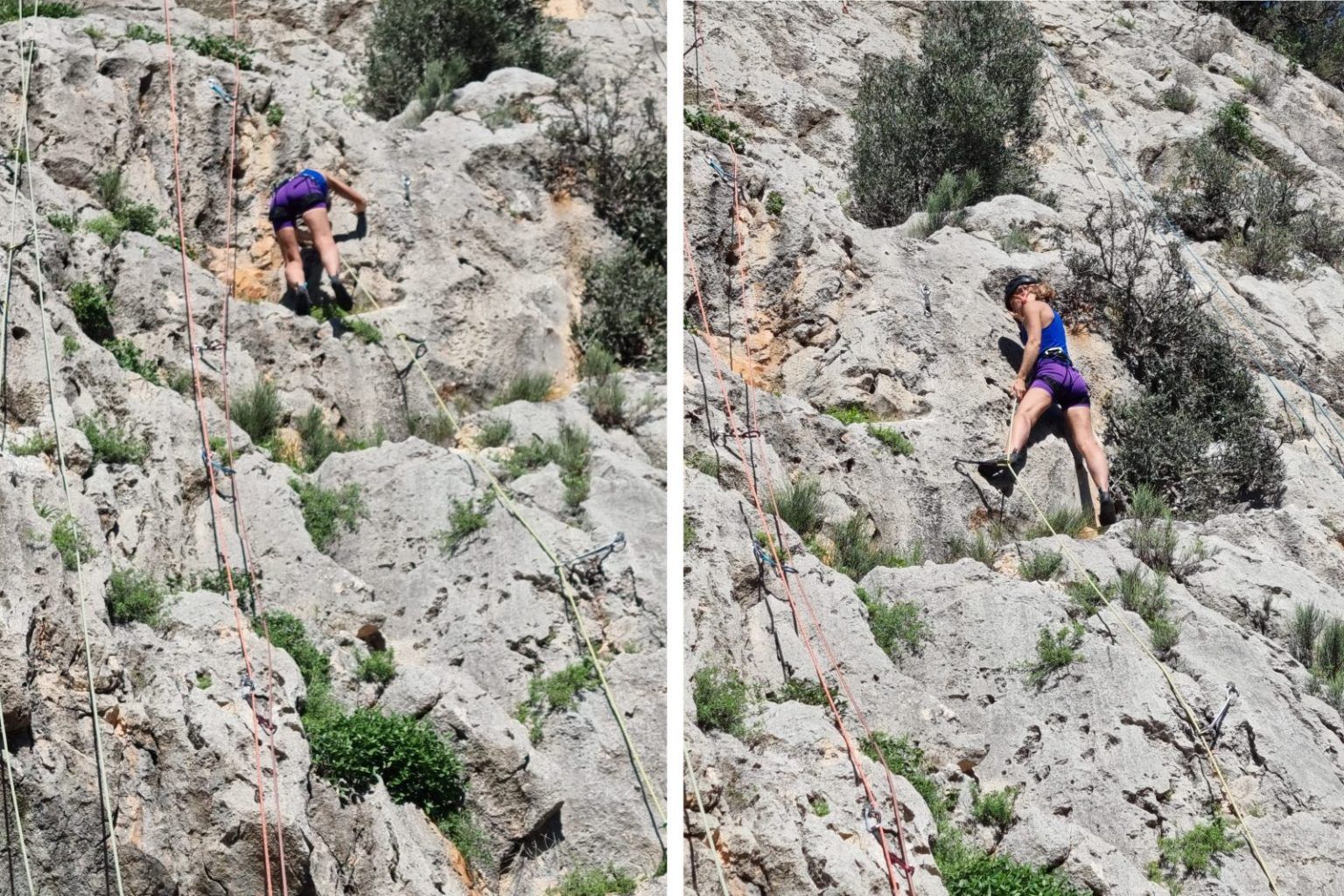
NOTE: It is not always safest to just stay close to the bolt. On many occasions it can be less safe to be directly above or close to the bolt. It is necessary to be aware of the terrain below you as you move and not just assume that staying close to the bolt will be enough to keep you safe.

Left: Risk involved: climber is climbing above a ledge to get to the bolt, risking falling onto it.
Right: Safe: climber is standing on the ledge while clipping the bolt, so she can´t fall onto it.


Summary

The steps of the climbing framework are: 

  • What is my destination; where do my feet need to be to clip the next bolt?
  • What is the least steep route for your feet to get to that destination?
  • Is the chosen route within what is an acceptable risk for you?

To accompany this article, please watch the Climbing Framework Video on the Rock & Sun YouTube channel.

This climbing framework has been developed by Rock and Sun (Trevor Massiah, MCI & Desiree Massiah-Verbeek, RCI) and was published in The Professional Mountaineer, December 2024.

How to improve your onsight grade

How to improve your onsight grade

As climbing instructors we aim to contribute to positive climbing experiences. It is our goal to try and get the most out of people’s potential. An onsight close to your max is one of the most positive climbing experiences to be had. So this blog is all about How to Improve your Onsighting ability. Because let’s admit it: nobody likes blowing their onsight.


What is onsighting?

Onsighting is climbing a route “on sight”. This means that you climb a route without falling or resting on the rope, in your first attempt, without prior knowledge. Even watching a video online might negate the onsight.


Onsighting – a once in a lifetime opportunity

Onsighting is very special because you only get to have one go at it. If you fall, it’s over: you have ‘blown the onsight’. It is no longer and will never ever be an onsight again. (Unless you would like to call it an Alzheimer Onsight when you come back to the route years later and claim to have no recollection of it).

Every route in the world only has one onsight opportunity for each climber. As opposed to redpointing where the climber may need 10 attempts, or a 100, or where it may take the climber years of going back to the same route to practice it and get it completely dialled until they finally (if at all) get it done. The special thing about the onsight is that you only have one opportunity to get it. So you want to give it your full attention. You want to maximise your chances of performing well.

Another way to show the importance of onsight is that if you’re not careful you may run out of routes to onsight. This is most likely to happen in your local climbing area of course, especially if you are not giving it your all any time you set off on a new route. Personally, I deliberately save certain routes for when I am better equipped and more likely to get the preferable onsight experience (which for me is: climbing something that is just about doable but will take a lot of concentration, effort and puzzle solving). So, rather than toproping the route when someone offers me that opportunity, and rather than getting on lead on it just to try some of the moves, I’ll say no until I think I’m ready to give it a proper go.


Why Onsighting?

Climbing is puzzle solving, and onsighting may be the ultimate puzzle: the rock is the crossword, sudoku or 1000 piece Jigsaw puzzle, and you are the one to solve it, with all the tools and strategies you have available to you. Redpointing you can compare to being able to use the ‘crossword-dictionary’, or pencilling in some optional numbers in the sudoku before picking which one it is, or using the picture on the box to see what the Jigsaw puzzle will look like. When onsighting, you set yourself the challenge to solve the puzzle without any help, all by yourself, without mistakes (unless they are mistakes you can rewind, for instance by climbing back down to a rest).

Onsighting close to your max grade is a very rewarding experience; you’ll be fully consumed with the climbing, using all your skills to solve this puzzle. We all have memories of climbing and everything seemed to ‘flow’, where we were fully engaged with the rock, with the moves, and we lost all sense of time and surroundings, completely focused on climbing. We are most likely to experience this state of flow when the challenge of the route hits the exact sweet spot of your capabilities to climb it[i].

Another reason why many climbers prefer onsighting over redpointing, is that it can be a very positive experience: a successful onsight takes only 1 go, whereas a successful redpoint takes more attempts; i.e. the climb-success ratio is per definition higher. (That is of course if climbers measure ‘success’ as reaching the chains – which most climbers do). A climber can onsight 4 routes in a day, whereas it is highly unlikely to redpoint 4 routes in a day.


Improving onsight grade vs ‘normal’ climbing grade

How is Improving someone’s onsight grade different from improving someone’s climbing grade? This blog is not so much about improving your climbing skills (read our previous blog about Climbing Skill Sets here), and thereby improving your grade. What we mean with Improving your onsight grade in particular, is to get better at climbing a route without any previous knowledge of the route. Ultimately the aim is to get your onsight grade closer to your redpoint grade, and to have more of those ‘fully-engaged-flow-like’-climbing experiences.

Some people have a huge gap between what they can climb when they work a route and what they can climb without previous knowledge or experience of the route. This can be the case when choosing routes that are too easy for them, routes that are well within their max. Especially when on a climbing holiday (as opposed to climbing in their local area) many climbers prefer this, allowing them to climb as many different routes as possible. The onsight-redpoint gap can also be big for those climbers spending years on redpointing a certain route; their onsight grade is usually quite a bit lower than the grade they are trying to project.


Three main ways to improve your Onsight ability

  1. Route finding is crucial in onsighting. Most failed onsights are due to having gone the wrong way. As climbers, it is our job to find the easiest way to climb the rock. Make it any harder than necessary and you’re increasing the chance of getting into trouble, getting pumped, or even falling off. Route finding starts on the ground. From here, gather as much information as you can. Where is the anchor? Where are the bolts? Look at differences in the angle of the rock and any of its features that stand out. Where is it less steep? Where is it more featured? Spot any potential rests. Where do you think the crux or cruxes are – f.i. based on the angle of the rock and/or the bolts being closer together? Using a laser pen while doing this can help hugely so climber and belayer are talking about and looking at the same thing. The belayer can then remind the climber when going elsewhere than was decided from the ground[ii]. Please remember though that although on-ground-route-finding is crucial, that doesn’t mean that this is where it ends. While climbing you need to constantly ask yourself the question where the route goes. And it is also necessary to realise that you can downclimb. Climb up, get information about the holds, then climb back down to the rest, and then decide on your route to what you think will be the next rest.

An extra note to people with limited outdoor experience: the climbing does not necessarily go straight over the bolts; it is a ‘route’ and it is your job to find it. The bolts are there to help protect you from hurting yourself should you fall off, and to keep the rope in an as straight as possible line. You are free to go anywhere left and right of the bolts as long as it is safe to do so. “That hold is on the other route” is very much ‘indoor-climbing-speak’. Mother nature didn’t decide that certain edges belong to this or the other route. Even route setters don’t decide on this. Their aim is simply to create climbing and to make it as safe as possible.


  1. A deeply ingrained understanding of the basic movement pattern hugely helps when onsighting. It is important to understand what efficient movement is, and to easily recognise which moves to do given the holds available to you, wasting as little time and energy as possible. The more the principles of efficient climbing have sunk in, both in your thinking as well as in your muscle memory, the quicker you’ll see the correct crux sequence. When I get stuck at a certain section of the route, I know where to look for feet, and I can think ahead: for instance seeing a right handhold, I will look for a left foothold below it. Or when I want to release the low right foot, I automatically look for a left hand above my head and a push down for my right hand. It is consciously thinking about these things that will help you work out the crux sequences quicker, thereby saving energy. If you are not sure as to whether you fully understand the basic movement program, then we highly recommend to come on a Performance Coaching Course, and to be disciplined to keep climbing efficiently afterwards.

Besides a thorough understanding of efficient movement, what also helps to improve your onsighting ability is to increase the number of moves in your ‘climbing repertoire’, for instance by redpointing harder routes.


  1. Getting in the right mindset before stepping on the rock certainly increases your onsighting potential. We like to remind people that they have done their preparation, and that is now time to trust their capabilities and enjoy the process of going into the unknown. Trust the body’s capability to climb and at the same time be very determined. The mindset should be very different from when you’re warming up, or from when you are climbing a route you’ve climbed before, or from when you’re in the process of redpointing. When onsighting especially, you need to set yourself up for:
  • When it gets hard, I will fight harder. I will certainly not say “take”.
  • If I make a move that’s wrong and I can’t reverse it, then I will keep going and risk falling.
  • If I can’t find the technical solution to solve the crux, then I will do it ugly and waste energy. As long as I have been conserving energy on the easier sections of the route, I should be fine. Plus, I may be able to recover higher up the route. It is important to get the balance right between time spent on working out a technical solution and the energy spent while looking for that solution.

What can also help to increase your onsight ability is to do Fall Practice regularly. We want our brains to quickly move from assessing the risk of falling back to focusing on how to climb the next section of the route. Being able to be calm above a bolt means all your focus and attention can remain on the climbing task at hand. Any distractions such as a fear of falling divert part of the brain away from climbing which means you are less likely to succeed in the onsight.


What to do when you’ve blown the onsight?

Accept that you are not going to onsight every route you get on. (If you do, you are climbing below your max. and should be aiming to onsight harder routes). If you are choosing the right challenges for yourself, then you will sometimes fail and you should be prepared to fail. We think it’s a shame that many people walk away from a route when they failed to onsight it. Some do so because they are on holiday and don’t want to ‘waste’ more time on doing the same route again, when they could be climbing a new route. We understand that. But there’s also many people that don’t give it another try because they think they’re not good enough to climb the route. By not giving it a 2nd or 3rd attempt (basically a quick redpoint), they are essentially collecting failures, and missing out on a valuable learning opportunity. There are many gains to be had from turning ‘failures’ into success by redpointing a route. We will go deeper into redpointing in a future blog.

(written by Desiree Verbeek)

[i] For more information about Flow: Csikszentmihalyi, The Rock Warrior’s Way (Arno Ilgner), Hazel Findlay.

[ii] Our next blog will be about route-finding.